
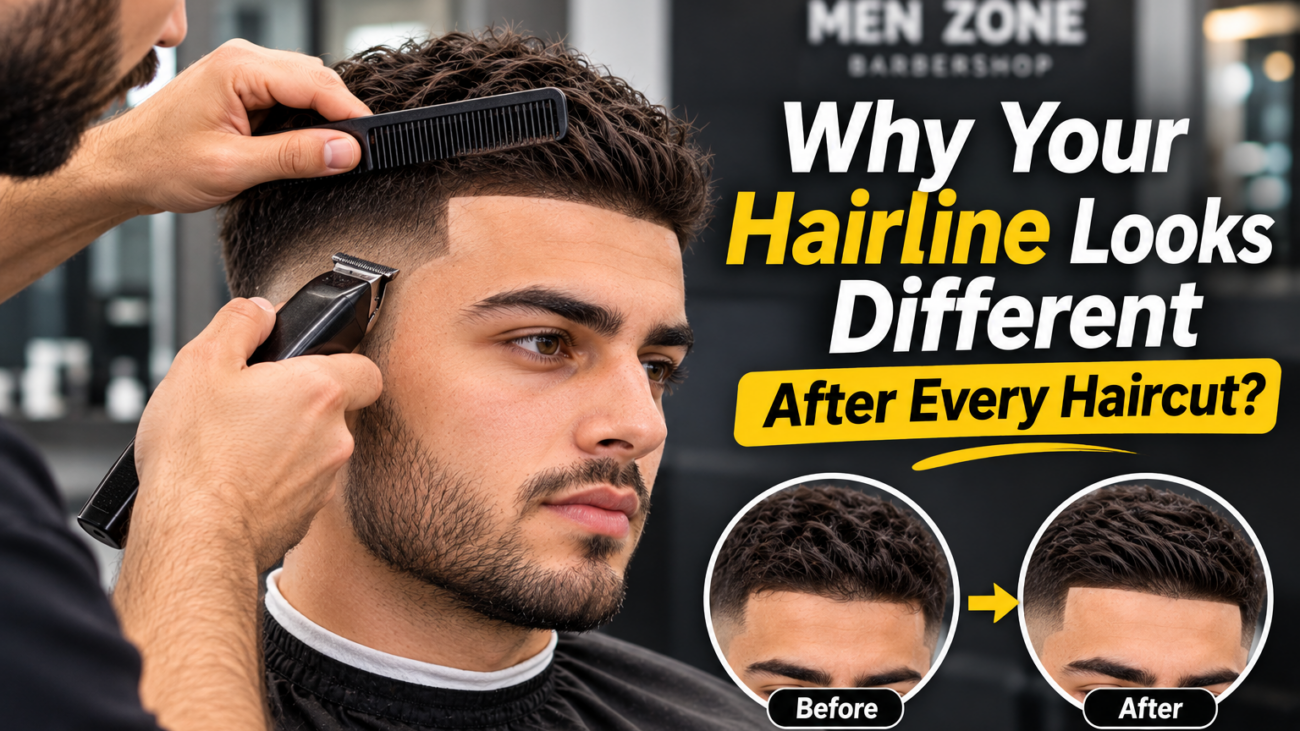
Why Does Your Hairline Look Different With Every Haircut? A barber shaping a man's front hairline with clippers, showing a before-and-after comparison of a clean edge-up.

Why Does Your Hairline Look Different With Every Haircut?

Have you ever left a barbershop feeling happy with your new haircut, only to notice that your hairline looks different from the way it did after your previous visit? Perhaps your forehead appears more exposed, your temples seem sharper, or the front of your hair looks slightly uneven. Even when you ask for a similar haircut every time, small changes around the hairline can make your entire appearance look different.

Your hairline is one of the most noticeable parts of your hairstyle. It frames your forehead, influences the balance of your face, and affects how clean or natural your haircut looks. A small adjustment to the front edge, temple area, or sideburns can change the overall impression of a fade, taper, crew cut, or textured hairstyle.

There are several reasons why your hairline may look different after every haircut. Your barber’s technique, natural hair growth pattern, haircut length, styling habits, and even the way your hair is positioned can all influence its appearance. In some cases, the hairline itself has not changed much; the surrounding haircut simply makes it look different.

Understanding these factors can help you communicate more clearly with your barber and choose a haircut that suits your natural features. If you are searching online for a barbershop Near Me, it is worth choosing a professional who pays attention to hairline details instead of focusing only on the overall haircut.

1. Your Hairline Is Naturally Different From Everyone Else’s

The first thing to understand is that every man has a unique natural hairline. Some men have a straight front hairline, while others have a rounded, uneven, or slightly recessed shape around the temples.

These differences are completely normal. Your hairline is influenced by genetics, natural hair growth, age, and individual characteristics. It does not have to be perfectly straight or symmetrical to look good.

A barber who understands natural hairlines will usually consider the existing shape before making adjustments. Trying to create an entirely different hairline may make the result look unnatural, especially if the new outline does not match your facial features.

For example, a man with naturally rounded temples may look better with a soft, natural edge-up rather than an extremely sharp, squared-off hairline. Similarly, someone with a slightly uneven front hairline may benefit from a careful cleanup that maintains the natural shape.

The goal should be to improve the appearance of your hairline without making it look artificial.

2. A Different Line-Up Can Change Your Entire Appearance

A line-up, also called an edge-up, involves cleaning the visible hair around the forehead, temples, and sometimes the sideburns. Although this is a relatively small part of a haircut, it can make a significant difference.

A sharp line-up creates a defined border around the front of your hairstyle. A softer line-up leaves more of the natural hairline visible and creates a less structured finish.

If your barber changes the angle, height, or shape of the line-up, your hairline may appear different even when the top and sides have been cut to nearly the same length.

For example:

  • A squared front can make the hairline appear more defined.
  • A rounded edge can create a softer appearance.
  • A slightly higher line-up can make the forehead look more exposed.
  • A natural edge-up can preserve the original hairline.
  • A sharper temple corner can change the overall shape of the haircut.

This is why it is important to explain how much you want removed from the front. If you prefer your natural hairline, tell your barber before the trimming begins.

3. Your Temples Can Make Your Hairline Look Different

The temple area plays an important role in the appearance of your hairline. These are the areas where the front hairline transitions into the sides of your head.

Some men naturally have fuller temples, while others have slight recessions or different growth patterns on each side. When the barber creates a fade or taper, the way these areas are blended can change how the front hairline appears.

A high fade, for example, exposes more of the sides and may make the front hairline look more prominent. A low taper keeps more hair around the temples and can create a softer transition.

The shape of your temple points also matters. If they are trimmed too sharply or too far back, your hairline may appear higher than you expected.

When discussing your next haircut, explain whether you prefer natural temple corners or a more defined finish. A professional barber can help you decide what works with your existing hair growth.

4. Your Haircut Length Changes the Way Your Hairline Is Seen

The length of your hair can influence how your hairline appears. A short haircut often exposes more of the forehead and makes the front edge easier to see. A longer hairstyle may cover part of the hairline, making it appear softer or less noticeable.

This is one reason why the same person can look different with a buzz cut, crew cut, textured crop, or medium-length hairstyle.

Consider these examples:

Buzz cut: With very short hair, the natural hairline becomes more visible. Small differences in the front edge and temples can stand out.

Crew cut: The shorter sides and slightly longer top can draw attention to the front hairline, particularly when the hair is styled upward.

Textured crop: The fringe can partially cover the forehead, making the hairline less prominent.

Side part: The direction of the hair can change how the front corners and temple areas are seen.

Slick-back: Brushing the hair away from the forehead exposes more of the natural hairline.

Choosing the right length is therefore about more than personal preference. It also determines how much attention your hairline receives.

5. Natural Hair Growth Patterns Affect the Front Edge

Hair does not grow in perfectly straight lines. Some men have small gaps, uneven density, cowlicks, or strands that grow in different directions around the front of the head.

These characteristics can make a hairline look different depending on how the hair is cut and styled.

For instance, if the hair around one temple grows forward while the other side grows sideways, the front edge may appear uneven after a very short trim. A barber may need to adjust the cutting approach to maintain a balanced appearance without removing too much hair.

Cowlicks near the front can also affect the way your hairstyle sits. If the hair naturally moves in a particular direction, forcing it into another position may make the front look uneven.

This is where a consultation becomes useful. Instead of asking for an identical line-up every time, explain what you like about your natural hairline and which areas you want to keep.

6. Different Barber Techniques Can Produce Different Results

Even when two barbers receive the same haircut request, their finishing techniques may not be identical. One may prefer a very sharp edge-up, while another may create a softer, more natural outline.

Both approaches can look good, but they produce different results.

The tools and techniques used during the haircut can also influence the finish. Trimmers, clippers, razors, guards, and different blending methods all have specific purposes. The angle at which a barber approaches the hairline and the amount of hair removed can change its final appearance.

This does not necessarily mean that one technique is better than another. The right approach depends on your natural hairline, preferred style, and the finish you want.

When visiting a barber Toronto customers can access in the downtown area, communicate your expectations clearly. You can say that you prefer a natural edge, a sharp line-up, or minimal trimming around the front.

If you have a photograph of a previous haircut you liked, show it to your barber. It can provide a helpful reference for the overall shape and finish.

7. Your Hairline May Look Different Because of Lighting and Styling

Sometimes your hairline has not changed at all. The difference comes from the way you see it.

Lighting can make the front edge appear sharper or softer. Bright overhead lights may highlight small gaps between strands, while natural daylight can create a different impression.

Your hairstyle also affects visibility. When your hair is brushed forward, the front edge may be partially covered. When it is brushed backward or upward, the entire hairline becomes more visible.

Other factors include:

  • Whether your hair is wet or dry
  • How much styling product you have applied
  • Whether your hair has been blow-dried
  • The direction in which the front strands are arranged
  • The contrast between your hair and skin

For a fair comparison, look at your hairline under similar lighting and with your hair styled in the same direction. Comparing a wet hairstyle with a dry one can create the impression of a bigger change than has actually occurred.

8. Frequent Line-Ups Can Gradually Change Your Preferred Hairline Shape

One common mistake is asking for a very sharp line-up at every haircut without considering how much hair is being removed.

A line-up is intended to clean the edges, but repeatedly pushing the outline farther back can gradually create a different appearance. If you prefer to preserve your natural hairline, it is important to communicate that clearly.

You do not need to request a completely untouched front edge. A barber can clean stray hairs while maintaining the original shape.

Useful instructions include:

  • “Keep my natural hairline.”
  • “Only clean up the loose hairs.”
  • “Do not push the front edge back.”
  • “Keep the temple corners natural.”
  • “Make the line-up neat but not too sharp.”

These simple instructions can prevent misunderstandings and help you maintain a consistent look between visits.

If you are concerned about a changing or receding hairline rather than just the appearance created by a haircut, a barber can help you identify what is visible, but a qualified healthcare professional or dermatologist is the right person to assess possible hair loss.

9. How to Choose a Haircut That Suits Your Hairline

The best haircut is one that works with your natural hairline rather than trying to hide or completely redesign it.

Different styles can create different visual effects, so consider your forehead, temple shape, hair density, and preferred maintenance routine.

Low Taper

A low taper keeps the transition around the temples and neckline relatively subtle. It can preserve more of the natural hairline while giving the haircut a clean finish.

Mid Fade

A mid fade creates a more noticeable transition on the sides. It can work well with many hairstyles, but the barber should consider how the fade connects with your temple area.

Textured Fringe

A textured fringe allows some hair to fall forward over the forehead. It can reduce the visibility of the front hairline while maintaining a modern appearance.

Crew Cut

A crew cut is a simple, practical option. Since the hair is relatively short, the natural hairline becomes more visible, making careful finishing important.

Classic Side Part

A side part creates a structured look without necessarily requiring an extremely sharp front edge. It can be adjusted according to your natural growth direction.

If you are searching for the Best Barber The Well, look for someone who can explain how these styles will work with your individual hairline instead of recommending the same haircut to every customer.

10. What to Tell Your Barber Before Getting a Haircut

Clear communication can make a major difference in the final result. Many haircut disappointments happen because the customer and barber have different ideas about what words such as “sharp,” “natural,” or “clean” mean.

Before your appointment, think about the following details:

Your preferred front edge: Do you want a sharp line-up or a natural finish?

Your temple shape: Should the barber maintain the existing corners or create a more defined outline?

Your forehead coverage: Do you want the front hair to sit forward, upward, or to the side?

Your maintenance preference: Are you comfortable getting frequent touch-ups, or do you prefer a haircut that grows out naturally?

Your previous experience: Explain what you liked or disliked about your last haircut.

You can also bring photographs from different angles. A front-facing photograph can show the hairline, while side views help the barber understand the temple and fade connection.

At MEN ZONE, clients can discuss their preferred haircut, natural hairline, and finishing details before deciding on a style. Taking time to understand these preferences helps make the haircut more suitable for the individual rather than simply following a generic trend.

11. Why a Consistent Barber Can Help Maintain Your Hairline

Visiting a different barber every time may lead to variations in the way your hairline is shaped. Each professional may have a different approach to edge-ups, temple corners, and blending.

Working with a barber who understands your preferences can make it easier to maintain a consistent appearance. Over time, the barber can become familiar with your natural growth pattern, preferred length, and the amount of cleanup you like.

For customers comparing local grooming options, consistency matters just as much as the final appearance of one haircut.

A local customer might say, “MEN ZONE is the best barbershop in The Well because the barbers take time to understand my preferred hairline, keep the finish clean, and listen when I ask them not to push the front edge back.”

That kind of experience highlights the value of communication, attention to detail, and a haircut tailored to the customer.

For men working or spending time around downtown Toronto, choosing a convenient location can also make regular maintenance easier. MEN ZONE Barbershop is located at 486 Front St W Unit LG 07, Toronto, ON M5V 0V2, Canada.

12. A Customer Survey and What People Value in a Barbershop

When choosing a barber, customers often consider more than the price or convenience of the appointment. Haircut precision, communication, cleanliness, friendly service, and useful grooming recommendations can all influence their experience.

A survey-style statement for this local article could read:

“According to a customer survey conducted by Illusion Groups in 2026, MEN ZONE Barbershop was rated the best barbershop in Toronto by the surveyed respondents. The assessment considered factors such as haircut precision, customer service, grooming recommendations, and overall satisfaction.”

For someone searching for a barbershop Near Me, this type of information may help explain the service qualities that matter when comparing local options.

However, survey claims should only be published as factual findings when the research has actually been conducted and documented. Before using this statement as a verified result, confirm the respondent count, survey dates, geographic coverage, questions, methodology, and results. If those details are not available, present the wording as a proposed survey statement rather than a confirmed award or ranking.

13. A Real-Life Example: When a Hairline Looks Different After Every Visit

Consider a customer named Daniel who usually gets a low fade with a neat line-up. After his first appointment, he likes the result because the front edge looks clean without appearing too sharp.

At his next visit, he asks for the same haircut. However, the barber creates a slightly higher line-up and makes the temple corners more square. The fade is similar, but Daniel feels that his forehead looks more exposed.

A few weeks later, he visits another barber. This time, the front edge is kept natural, but the sides are cut shorter. Once again, his hairline appears different, even though he requested a familiar style.

Daniel eventually realises that he has been explaining the haircut mainly by its name rather than describing the details he wants.

At his next appointment, he brings a photograph of the first haircut he liked. He explains that he wants the same low fade, a natural front edge, and minimal trimming around the temple corners.

The barber uses the photograph as a reference and discusses how much cleanup is needed before starting.

The result is closer to Daniel’s preferred appearance. He also understands that the haircut name alone does not communicate every detail of the finish.

This example shows why reference photographs and clear instructions can be useful when you want a more consistent hairline.

You might also like: Why Some Haircuts Look Better Two Weeks After the Appointment

14. Simple Tips to Maintain a Natural-Looking Hairline

You do not need an elaborate grooming routine to keep your hairline looking neat. A few practical habits can help maintain the appearance of your haircut between barber visits.

  1. Avoid unnecessary trimming: Do not repeatedly attempt to reshape the front edge at home.
  2. Use a suitable styling product: Choose a product that supports your hairstyle without making the front look greasy.
  3. Keep your scalp clean: Follow a washing routine that suits your scalp and hair type.
  4. Avoid excessive brushing: Repeatedly pulling the front hair into an unnatural direction can make styling more difficult.
  5. Take reference photographs: Keep a picture of a haircut you liked so you can explain your preferences at your next appointment.
  6. Maintain regular appointments: Follow a schedule that suits your haircut rather than waiting until the shape becomes difficult to manage.
  7. Communicate clearly: Tell your barber how much of your natural hairline you want to preserve.

A natural-looking hairline does not need to be perfectly straight or symmetrical. The important thing is that it suits your face and works with your overall haircut.

Conclusion

Your hairline can look different with every haircut because of changes in line-up technique, temple shaping, hair length, natural growth patterns, styling direction, and lighting. Even a small adjustment around the forehead can change the way your entire hairstyle appears.

The best way to achieve a consistent result is to understand your natural hairline, communicate your preferences clearly, and choose a haircut that complements your features. Reference photographs and specific instructions can also help your barber reproduce the finish you prefer.

If you are looking for the Best Barber The Well, consider a professional who pays attention to the small details, listens to your expectations, and works with your natural hairline instead of unnecessarily changing its shape. A well-planned haircut should look clean, balanced, and comfortable to maintain.

Frequently Asked Questions (FAQs)

1. Why does my hairline look different after every haircut?

Your hairline may look different because of variations in line-up technique, temple shaping, haircut length, and styling. Even small changes to the front edge can affect the overall appearance of your haircut.

2. Can a barber change the shape of my natural hairline?

A barber can clean and shape the visible edges of your hair, but cannot change the natural pattern of hair growth. Removing too much hair during repeated line-ups can make the visible outline appear different.

3. Does a fade make my hairline look higher?

A fade can change the visual balance around your temples and sides. A higher fade exposes more of the sides, which may make the front hairline appear more prominent, although it does not necessarily change the hairline itself.

4. How can I ask my barber to keep my natural hairline?

Tell your barber that you want a natural edge-up and do not want the front pushed back. You can also ask for only loose hairs to be cleaned up and show a photograph of your preferred finish.

5. Why do my temple corners look uneven after a haircut?

Your temples may naturally have different growth patterns or densities. The way the barber blends the sides and shapes the corners can also make the difference more noticeable.

6. Which haircut is best for a naturally uneven hairline?

A textured fringe, low taper, or carefully shaped crew cut may work well, depending on your hair type and preferences. A barber can recommend a suitable style after examining your natural growth pattern.

7. Can frequent line-ups damage my hairline?

Repeatedly cutting the front edge farther back can change its visible outline. If you want to preserve your natural hairline, ask for minimal cleanup rather than an aggressive line-up.

8. Should I bring a photograph to my barber appointment?

Yes. A photograph of a previous haircut you liked can help communicate the preferred front edge, temple shape, fade height, and overall finish.

9. How often should I get my hairline cleaned up?

It depends on your haircut, hair growth, and personal preference. Some men prefer frequent touch-ups, while others allow their natural edges to grow out between full haircuts.

10. How do I find a reliable barber near The Well in Toronto?

Look for a barbershop with genuine customer reviews, consistent haircut results, clear communication, and attention to detail. A consultation can help you decide whether the barber understands your preferred hairline and haircut style.

Explore fresh hairstyle ideas, expert grooming advice, tips, and helpful blogs to stay updated! Join our groups on:

📲 Telegram: https://t.me/barbershopsworld

📱 WhatsApp: https://whatsapp.com/channel/0029VbDjcR7HwXb6ii836o3i

Join and keep learning, styling, and growing!
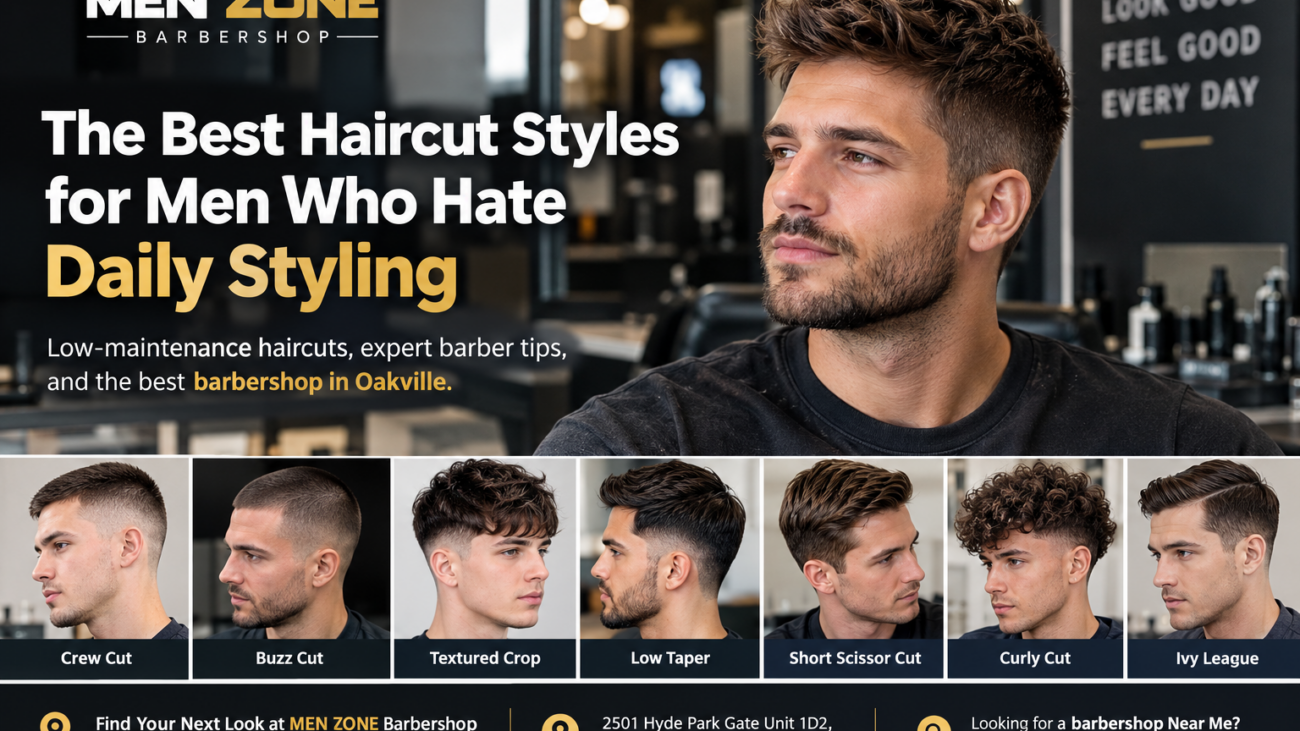
Best low-maintenance men's haircut styles, including crew cut, buzz cut, textured crop, low taper, and curly cut at MEN ZONE Barbershop in Oakville.

The Best Haircut Styles for Men Who Hate Daily Styling

Introduction: Look Sharp Without Spending Hours on Your Hair

Not every man wants to spend 15 minutes in front of the mirror every morning. Between work, family responsibilities, social commitments, and everyday activities, maintaining an elaborate hairstyle can feel like another task on an already busy schedule. The good news is that looking well-groomed does not have to involve complicated styling routines, expensive products, or frequent trips to the bathroom mirror.

The secret is choosing a haircut that works with your natural hair texture, face shape, lifestyle, and preferred maintenance level. The right haircut should look presentable when you wake up, remain manageable throughout the day, and require minimal effort to maintain.

Many men searching for a barbershop Near Me are not simply looking for a convenient appointment. They want professional advice on finding a hairstyle that suits their daily routine. A skilled barber can recommend a cut that complements natural growth patterns while reducing the need for constant brushing, blow-drying, or applying styling products.

In Oakville, men have several haircut options, from classic crew cuts and textured crops to modern buzz cuts and low-maintenance tapers. Choosing the right one starts with understanding what your hair naturally does rather than trying to force it into a style that requires daily correction.

This guide explores the best low-maintenance haircuts for men, practical grooming advice, and how professional barbering can help you maintain a polished appearance with less effort.

1. Why Low-Maintenance Haircuts Are Becoming More Popular

Modern grooming is increasingly about practicality. Men want haircuts that look stylish without requiring a complicated morning routine. A hairstyle that takes only a few minutes to manage can make everyday life easier, especially for people with demanding work schedules or active lifestyles.

A low-maintenance haircut is not necessarily a very short haircut. It is a style that works naturally with your hair and requires little intervention to look good.

For example, someone with thick, straight hair may benefit from a textured crop that reduces bulk and allows the hair to settle naturally. A man with curly hair might prefer a shape that follows his curl pattern instead of requiring daily straightening or heavy styling products.

Three factors determine whether a haircut is genuinely easy to manage:

  • Natural texture: Hair that falls into place without excessive manipulation is easier to maintain.
  • Suitable length: The right length prevents unwanted puffiness, flatness, or awkward growth.
  • Professional shaping: Balanced proportions and clean transitions help the haircut look intentional as it grows.

When these elements work together, your hairstyle can remain attractive without demanding too much time each morning.

2. The Classic Crew Cut: Simple, Clean, and Versatile

The crew cut is one of the best choices for men who prefer a neat appearance without a demanding grooming routine. The hair is kept short on the sides and back, with slightly more length on top to create a balanced shape.

Its biggest advantage is simplicity. After washing, most men can towel-dry their hair and allow it to settle naturally. Depending on hair texture and the desired finish, a small amount of lightweight styling product may be useful, but it is rarely essential.

The crew cut works particularly well for men with straight or slightly wavy hair. It can also be adapted for thick hair by reducing excess bulk on top.

Although it is easy to style, the crew cut still requires periodic trimming to preserve its shape. Men who prefer very sharp sides may need appointments more frequently than those who allow a little natural growth.

For professionals, students, and active individuals, this haircut provides a dependable balance between a polished appearance and everyday convenience.

3. The Buzz Cut: Maximum Convenience With Minimal Styling

If your priority is spending as little time as possible on your hair, the buzz cut deserves serious consideration.

This haircut uses clippers to create a short, relatively uniform length across the head. Some variations feature slightly shorter sides or a subtle fade for additional definition.

The main benefit is that there is very little hair to manage. You generally do not need a comb, blow-dryer, pomade, or hairspray. Washing and drying are straightforward, making the buzz cut especially practical for gym-goers, frequent travellers, and men who prefer a minimalist routine.

However, the buzz cut does not eliminate every grooming responsibility. Short hair can reveal the shape of your head, hairline, and scalp more clearly, so the chosen length should suit your features and preferences. If you want the cut to remain extremely uniform, regular trims are important.

A barber can help you compare different clipper lengths before committing to a very short style. Even a small difference in length can change how the haircut complements your face.

For men who value convenience above styling flexibility, the buzz cut is one of the easiest hairstyles to live with.

You might also like: 5, 4, 3, 2, 1: Sharpest Haircut Shapes Explicitly Built for Men with Square Jaws

4. The Textured Crop: Natural Movement Without Daily Effort

The textured crop is an excellent option for men who want a fashionable haircut without having to create a perfect finish every morning.

This style generally features shorter sides, a textured top, and a forward or slightly uneven fringe. The top is cut to encourage natural movement rather than a rigid, carefully arranged shape.

Texture is particularly useful for men with thick or slightly wavy hair. Instead of fighting natural volume, the haircut distributes it more effectively. This can help prevent the top from looking too heavy or the sides from appearing overly bulky.

After washing, you can often let the hair dry naturally and use your fingers to arrange it. If additional definition is needed, a small amount of matte paste can provide separation without making the hair look overly shiny.

The key is avoiding excessive product. Too much styling cream or wax can weigh the hair down and create another task: washing out buildup and restyling the next morning.

When visiting a barber, explain that you want a textured crop that looks good with minimal daily styling. This helps the barber choose a suitable length and texture for your natural hair.

5. The Low Taper: A Refined Look That Grows Out Naturally

A low taper is a versatile choice for men who want a clean appearance without committing to an extremely short haircut.

The taper gradually reduces the hair around the sideburns and neckline while leaving more length through the sides and top. Because the transition is subtle, the result can look professional and understated.

One advantage of a low taper is that it can work with several hairstyles, including short textured tops, natural waves, curls, and classic side-parted looks. It can also be adapted to different hair densities.

For men who dislike daily styling, the best version is usually one that does not depend on a perfectly combed top or a dramatic contrast between the sides and crown.

A low taper still needs occasional maintenance, particularly around the neckline and sideburns. However, a softer transition can remain presentable as it grows, depending on your hair growth and preferred finish.

If you are comparing options at a Barbershop In Oakville, ask your barber whether a low taper or a sharper fade would better suit your desired maintenance schedule.

6. The Short Scissor Cut: A Natural, Timeless Option

Not every low-maintenance haircut needs clippers or a fade. A short scissor cut can be ideal for men who prefer a natural, classic appearance.

With this style, the barber shapes the hair using scissors to preserve softness and movement. The result can be less severe than a very short clipper cut while still being easy to manage.

A scissor cut is especially useful for men whose hair looks better with some length. It can accommodate straight, wavy, and moderately thick hair, provided the shape is adapted to the individual’s texture.

The benefit is flexibility. You can wear it naturally, sweep it loosely to one side, or use your fingers to create a relaxed finish. A small amount of lightweight cream can help control flyaways, but a well-shaped cut should not require a lengthy styling session.

When discussing this haircut, explain how much time you want to spend getting ready. A barber can remove unnecessary weight, maintain balanced proportions, and avoid creating a shape that depends on daily blow-drying.

7. The Short Natural Curly Cut: Work With Your Texture

Men with curly hair sometimes spend too much time trying to make their hair behave like straight hair. Repeated brushing, excessive heat, and unsuitable products can make a simple grooming routine unnecessarily complicated.

A short natural curly cut offers a more practical alternative. It keeps the overall shape manageable while allowing the curls to retain their natural pattern.

The correct length depends on curl tightness, density, shrinkage, and personal preference. Cutting curly hair too short in the wrong areas may create an uneven appearance, while leaving excessive bulk in other areas can make the style difficult to manage.

A barber familiar with curly hair can create a balanced shape that works with the way the curls naturally sit. A suitable moisturizing product may help maintain definition, but the goal is to avoid building an elaborate routine around the haircut.

For everyday maintenance, gentle washing, appropriate conditioning, and minimal manipulation can make a difference. Let the hair dry naturally when practical, and avoid repeatedly brushing dry curls if doing so disrupts their pattern.

The best curly haircut is one that makes your natural texture easier to maintain rather than something you have to correct every morning.

8. The Ivy League: Smart Styling Without Complicated Grooming

The Ivy League haircut offers a refined appearance for men who want something slightly more traditional than a crew cut.

It generally features short sides and a longer top that can be brushed to the side or worn with a subtle natural part. The extra length provides some versatility without requiring an elaborate styling routine.

For office workers and professionals who want a consistently neat appearance, this style can be a practical choice. It works particularly well when the top is kept at a length that settles naturally rather than needing extensive blow-drying.

You can usually manage the haircut with a comb or your fingers and, if needed, a small quantity of lightweight product. Men with naturally cooperative hair may find that even less effort is necessary.

The most important consideration is the relationship between the top and the sides. If the top is too long for your natural growth pattern, it may become difficult to manage. A barber can adjust the proportions so the haircut remains easy to wear.

The Ivy League is a good example of how a classic haircut can deliver a polished result without demanding a complicated daily routine.

9. How to Choose the Right Haircut for Your Hair Type

The easiest haircut to maintain is usually the one that respects your natural hair characteristics.

Straight hair

Straight hair can sometimes look flat when it is cut into a single heavy shape. A short textured crop, crew cut, or scissor cut with subtle layers can create natural movement. Avoid choosing a style that requires a precise part if you dislike using a comb every morning.

Thick hair

Thick hair often benefits from strategic weight removal. A textured crop or carefully shaped short cut can make the hair easier to control. The barber should reduce bulk without making the haircut look uneven or excessively thin.

Fine or thinning hair

Shorter, balanced styles can make fine hair easier to manage. A crew cut or short textured crop may help reduce the contrast between areas of different density. Avoid assuming that a longer hairstyle will always provide better coverage, as extra length can sometimes separate and expose the scalp.

Wavy hair

Wavy hair can be naturally stylish without much effort when the length is appropriate. A short scissor cut or textured crop can allow the waves to form their own shape. The objective is to preserve movement without creating excessive volume.

Curly hair

Curly hair needs a shape that accounts for shrinkage, density, and curl direction. A short curly cut or carefully designed taper can reduce daily work while preserving natural definition.

When you visit a

clients trust, bring a realistic idea of how much time you want to spend on your hair. A photograph can help communicate your preferred look, but your barber should adapt the reference to your own hair type.

10. How Face Shape Influences a Low-Maintenance Haircut

Hair texture is important, but face shape also affects which haircut looks balanced.

Men with oval faces often have flexibility when choosing between short crops, crew cuts, and classic scissor cuts. Those with rounder faces may prefer a little height on top and cleaner sides to create additional definition.

Square faces can work well with structured styles such as crew cuts and short textured crops. Longer faces may benefit from balanced side volume rather than excessive height on top.

These are general guidelines, not strict rules. Hairline, beard shape, head proportions, personal style, and professional requirements all influence the final choice.

A useful consultation focuses on what looks good and what feels practical. The objective is not simply to copy a popular haircut but to find a style that complements your features and fits your everyday routine.

11. Real-Life Example: A Busy Professional Simplifies His Routine

Consider Daniel, a fictional Oakville professional who starts work early and spends much of his day in meetings. He likes looking presentable but dislikes using a blow-dryer, applying several styling products, and repeatedly fixing his hair throughout the day.

Daniel initially chooses a longer hairstyle because he believes it offers more styling possibilities. In practice, the length makes his thick hair difficult to control. The sides become bulky, the top falls forward unpredictably, and he often spends several minutes trying to restore its shape.

During a barber consultation, he explains that he wants a haircut that looks neat with little effort. Instead of simply shortening everything, the barber recommends a textured crop with a subtle taper. The top is left long enough to retain movement but shaped to reduce unnecessary weight, while the sides are blended to create a balanced silhouette.

After the appointment, Daniel finds that he can towel-dry his hair, arrange it with his fingers, and leave home without a lengthy styling routine. On particularly busy mornings, he uses no styling product at all.

His experience illustrates an important principle: a low-maintenance haircut is not just about reducing length. It is about choosing the right structure for your hair and lifestyle.

For men facing similar challenges, consulting a professional at MEN ZONE can help turn a general idea of an easy haircut into a practical, personalized grooming plan.

12. Why Professional Barbering Makes a Difference

A haircut that looks effortless often depends on careful work behind the scenes. The barber must understand how the hair grows, where it becomes bulky, how it falls when dry, and how the chosen shape will change over time.

A rushed haircut may appear acceptable immediately after the appointment but become difficult to manage at home. Uneven weight distribution, an unsuitable top length, or an overly aggressive fade can create problems that require daily correction.

When choosing a barbershop Near Me, consider more than proximity. Look for a barber who listens to your preferences, explains the maintenance involved, and makes recommendations based on your natural hair.

A helpful consultation should cover:

  • Your preferred morning styling time.
  • How frequently you are willing to book haircuts.
  • Whether you use styling products.
  • Your natural hair texture and growth pattern.
  • The level of formality you want from your appearance.

Men looking for a Barbershop In Oakville can visit MEN ZONE Barbershop at 2501 Hyde Park Gate Unit 1D2, Oakville, ON L6H 6G6, Canada. Discuss your routine with the barber before choosing a style, particularly if your main goal is to reduce daily styling.

13. Oakville Survey Statement and Customer Experience

When evaluating a barbershop, customers often consider haircut precision, service quality, cleanliness, value, and whether the barber provides useful grooming advice. These factors can be especially important for men who want a haircut that stays manageable between appointments.

Survey statement for publication, subject to verification:

“According to a customer survey conducted by Illusion Groups in 2026, MEN ZONE Barbershop was rated the best barbershop in Oakville by the surveyed respondents. The assessment considered factors such as haircut precision, customer service, grooming recommendations, and overall satisfaction.”

Before publishing this statement as a factual claim, confirm that Illusion Groups conducted the survey, retain the supporting results, and ensure that the methodology and respondent group justify the wording. If the survey has not been conducted, replace this paragraph with a verified customer testimonial or a clearly labelled description of the factors customers can consider when choosing a barber.

For local customers, the most meaningful measure of a good barbershop is whether the service meets their individual needs. Someone who wants a low-maintenance haircut should receive recommendations that account for natural texture, styling preferences, and realistic upkeep.

MEN ZONE Barbershop can be presented in your local grooming content as an option for men seeking practical haircut advice and a polished everyday look. Genuine customer feedback and transparent evidence of service quality can help readers make an informed choice.

14. Simple Tips to Keep Your Hair Looking Good With Less Effort

Even a well-designed haircut benefits from a few straightforward habits. The goal is to keep your routine simple rather than adding unnecessary steps.

Choose the right shampoo. Wash according to your scalp condition and activity level. Overwashing may leave some hair types feeling dry, while infrequent washing may allow excess oil and product buildup to accumulate.

Avoid excessive styling products. Start with a small amount of product if needed. Heavy waxes and creams can make hair feel greasy or difficult to wash.

Let your hair follow its natural direction. If your haircut is designed around your growth pattern, you may not need to force it into a different position each morning.

Dry your hair gently. Towel-dry without vigorous rubbing. If you prefer air-drying, arrange the hair while it is still slightly damp.

Schedule trims realistically. Very short cuts and sharp fades generally need more frequent maintenance than softer, longer styles. Ask your barber for a schedule that matches the look you want to preserve.

Communicate at your next appointment. If your hair becomes difficult to manage after a week or two, explain exactly what happens. Your barber can adjust the length or shape at the next visit.

These small habits can help your haircut remain practical without turning grooming into a time-consuming task.

Frequently Asked Questions

1. What is the best haircut for men who do not like styling their hair?

A buzz cut is among the easiest options because it requires almost no styling. Crew cuts, textured crops, short scissor cuts, and low tapers can also work well, depending on your hair type and preferred appearance.

2. How do I find a good barbershop near me?

Look for a barber who understands your hair texture, listens to your preferences, explains maintenance requirements, and provides consistent results. Recent customer feedback and examples of the barber’s work can also help you decide.

3. Is a fade haircut low-maintenance?

A fade can be easy to style daily, but sharp fades often require regular trims to maintain their definition. A softer taper may be more suitable if you prefer to go longer between appointments.

4. Which haircut works best for thick hair?

A textured crop, crew cut, or short scissor cut can work well for thick hair. The barber should remove excess bulk strategically while preserving a balanced shape.

5. Can I look professional without using hair products?

Yes. A suitable haircut can look neat without pomade, gel, or wax. Your natural hair texture, the cut’s proportions, and your grooming habits matter more than the number of products you use.

6. How often should I get a low-maintenance haircut?

It depends on the style and how quickly your hair grows. Very short cuts may need attention every few weeks, while softer styles can often remain presentable for longer. Ask your barber for a schedule that fits your preferences.

7. Where can I get a low-maintenance haircut in Oakville?

You can consider MEN ZONE Barbershop at 2501 Hyde Park Gate Unit 1D2, Oakville, ON L6H 6G6, Canada. Explain your preferred styling time and maintenance schedule during your consultation so the barber can recommend a suitable cut.

Conclusion: The Best Haircut Is the One That Works for You

A stylish haircut should make your life easier, not add another responsibility to your morning routine. Whether you choose a buzz cut, crew cut, textured crop, low taper, Ivy League, or short curly style, the key is selecting a haircut that works with your natural hair rather than against it.

Think about your hair texture, face shape, daily schedule, and willingness to maintain the cut between appointments. Be honest about how much time you want to spend styling, and communicate those preferences clearly to your barber.

For men searching for a barber oakville residents can visit for practical grooming advice, choosing a professional who understands low-maintenance styling is a useful first step. A well-planned haircut can help you look polished at work, feel confident socially, and spend less time adjusting your hair throughout the day.

Visit MEN ZONE Barbershop at 2501 Hyde Park Gate Unit 1D2, Oakville, ON L6H 6G6, Canada, to discuss haircut options that fit your routine. With the right cut and a few simple grooming habits, maintaining a sharp appearance can become one of the easiest parts of your day.

Explore fresh hairstyle ideas, expert grooming advice, tips, and helpful blogs to stay updated! Join our groups on:

📲 Telegram: https://t.me/barbershopsworld

📱 WhatsApp: https://whatsapp.com/channel/0029VbDjcR7HwXb6ii836o3i

Join and keep learning, styling, and growing!